
SIP vs Lump Sum: Which One Really Wins in India? (2026 Data)
You have ₹1,00,000 to invest. Do you put it in all at once, or spread it out through a SIP over the next few months?
Ask a mutual fund distributor and you’ll hear: “Do SIP, it protects you from market ups and downs.”
Ask someone who follows the data and you’ll hear: “Lump sum wins, because your money gets more time in the market.”
Both are partly right. But they’re both skipping one simple question — the one that actually decides the answer for you:
Is this money already with you, or is it coming in bit by bit from your salary?
That’s it. That one question decides almost everything below.

Quick answer: SIP or lump sum?
| Your situation | What usually makes sense |
|---|---|
| You invest from your monthly salary | SIP |
| You already have a large amount ready to invest | Lump sum is worth considering |
| You got a bonus or a maturity payout | Lump sum, or split it into 2-3 parts |
| A big drop after investing would make you panic-sell | Split it in parts, or use an STP (explained below) |
| You’re waiting for the market to “crash” before investing | Be careful — that’s guessing, not investing |
| You don’t have an emergency fund yet | Build that first. Do this before either SIP or lump sum. |
No method guarantees higher returns. SEBI describes SIP simply as investing a fixed amount at regular intervals — this buys more units when prices fall and fewer when they rise, a mechanism called rupee-cost averaging. AMFI is clear that this does not guarantee profit and does not protect you from losses in a falling market. Keep that in mind whenever you read “SIP always beats the market.”
First, what SIP and lump sum actually mean
A SIP (Systematic Investment Plan) is not a separate investment product — it’s a method of putting money into a mutual fund. You pick a fund, an amount, and a date, and that fixed amount gets auto-debited from your bank account and invested every month (some apps also offer weekly or quarterly SIPs).
Lump sum means investing the entire amount you have, in one go, on one date.
Both methods can go into the exact same mutual fund. The fund’s returns don’t change based on which method you used to get in — what changes is when your money enters the market and how much of it is exposed at any given time.
Getting started costs very little. Per SEBI norms and current AMC practice, most funds let you start a SIP with ₹500 a month, and some allow as little as ₹100. SEBI has also been pushing fund houses toward a “Chhoti SIP” of just ₹250 a month, aimed specifically at first-time and lower-income investors. Lump sum minimums are typically ₹100-₹1,000 depending on the fund. In other words: you don’t need ₹1,00,000 to start. The number in this post’s opening example is just there to make the comparison concrete — the logic below applies whether you’re deciding between ₹1,000 a month or ₹1,00,000 today.
What the data actually shows
23 years of Nifty 50 returns, SIP vs lump sum
A rolling-return study on the Nifty 50 (2002-2025, about 700 time windows tested, SIP measured by XIRR and lump sum by CAGR) shows something closer to a coin toss than most people expect:
| How long you invest | SIP wins | Lump sum wins | What it means |
|---|---|---|---|
| 5 years | ~52% | ~46% | Almost 50-50; SIP does slightly better |
| 7 years | ~50% | ~50% | Dead even |
| 10 years | ~51% | ~47% | SIP still slightly ahead |
| 15 years | ~47% | ~52% | Lump sum pulls ahead — long-term compounding wins |
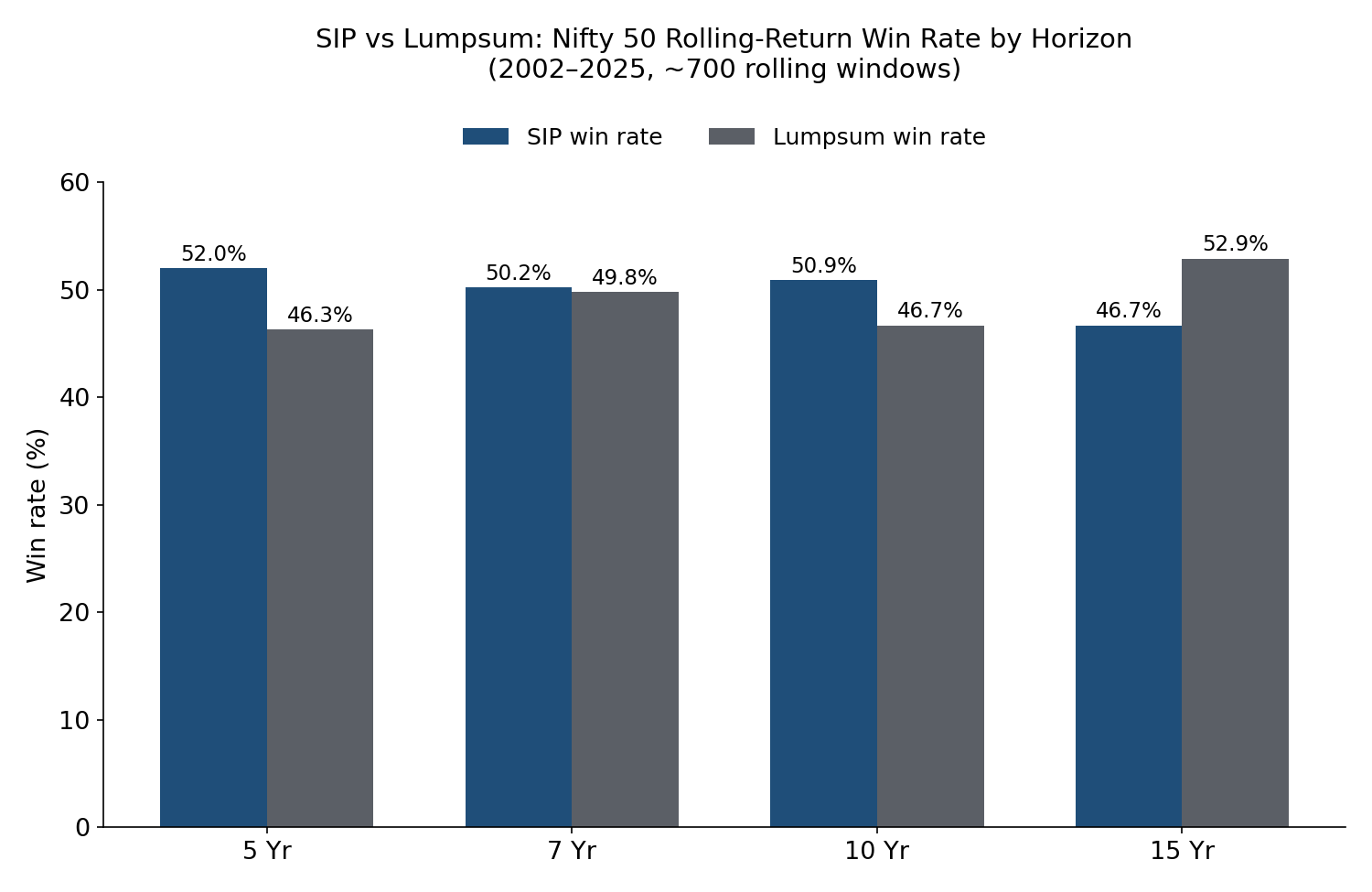
(This is a third-party backtest, not an official AMFI or SEBI number — treat it as a general guide, not a promise.)
The takeaway: over 15+ years, lump sum has a small edge because your money simply gets more time to grow. Over 5-10 years, it’s close to a toss-up — it depends on what the market does after you invest, not which method you chose. (You may have seen a claim that “lump sum wins two out of three times” — that number comes from US, UK, and Australian markets, not India, so it doesn’t apply here.)
SIP is now how most of India invests
This isn’t just theory. As of August 2026, AMFI data shows SIP contributions hit a record ₹32,297 crore in a single month, and the number of people with an active SIP crossed 10 crore for the first time. SIP money now makes up about 21% of the entire mutual fund industry.
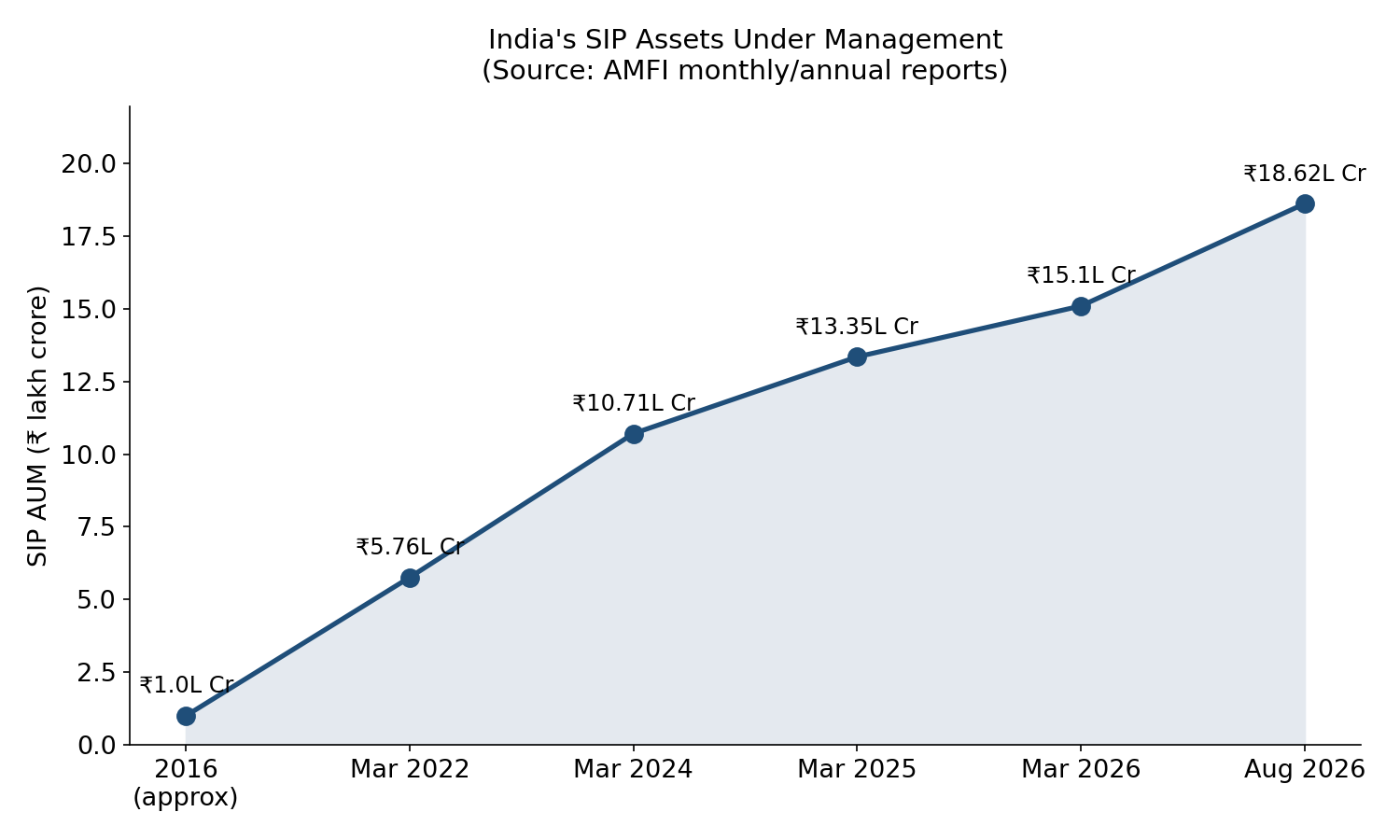
SIP money in India has grown from about ₹1 lakh crore in 2016 to ₹5.76 lakh crore by March 2022, ₹13.35 lakh crore by March 2025, and ₹18.6 lakh crore by August 2026 — figures straight from AMFI’s own reports.
A worked example: ₹1,00,000, two ways
Numbers make this easier to picture than percentages alone. Say you have ₹1,00,000 today, and you’re deciding between investing it all now, or spreading it as a ₹10,000 SIP over the next 10 months.
If the market rises steadily (say, roughly 1% a month for a year):
| Approach | Total invested | Approx. value after 12 months |
|---|---|---|
| Lump sum (all ₹1,00,000 on day one) | ₹1,00,000 | ~₹1,12,700 |
| SIP (₹10,000/month for 10 months) | ₹1,00,000 | ~₹1,08,300 |
The lump sum pulls ahead here — simply because more of your money was invested for more of the year.
If the market drops 20% right after you invest, then recovers over the year:
| Approach | What happens |
|---|---|
| Lump sum | Your full ₹1,00,000 takes the hit immediately, dropping to ~₹80,000 before recovering |
| SIP | Only the instalments already invested take the hit; later instalments buy in at the lower, post-crash price |
This is illustrative, not a forecast — real markets don’t move in neat straight lines. But it shows exactly why the “right” answer flips depending on what the market does after you invest, which is precisely the part nobody can predict in advance.
Why “rupee-cost averaging” actually works
The idea is simple. A fixed SIP amount buys more units when prices are low, and fewer when prices are high:
| Month | Fund price (NAV) | You invest | Units you get |
|---|---|---|---|
| Jan | ₹100 | ₹10,000 | 100 |
| Feb | ₹80 | ₹10,000 | 125 |
| Mar | ₹120 | ₹10,000 | 83 |
| Apr | ₹90 | ₹10,000 | 111 |
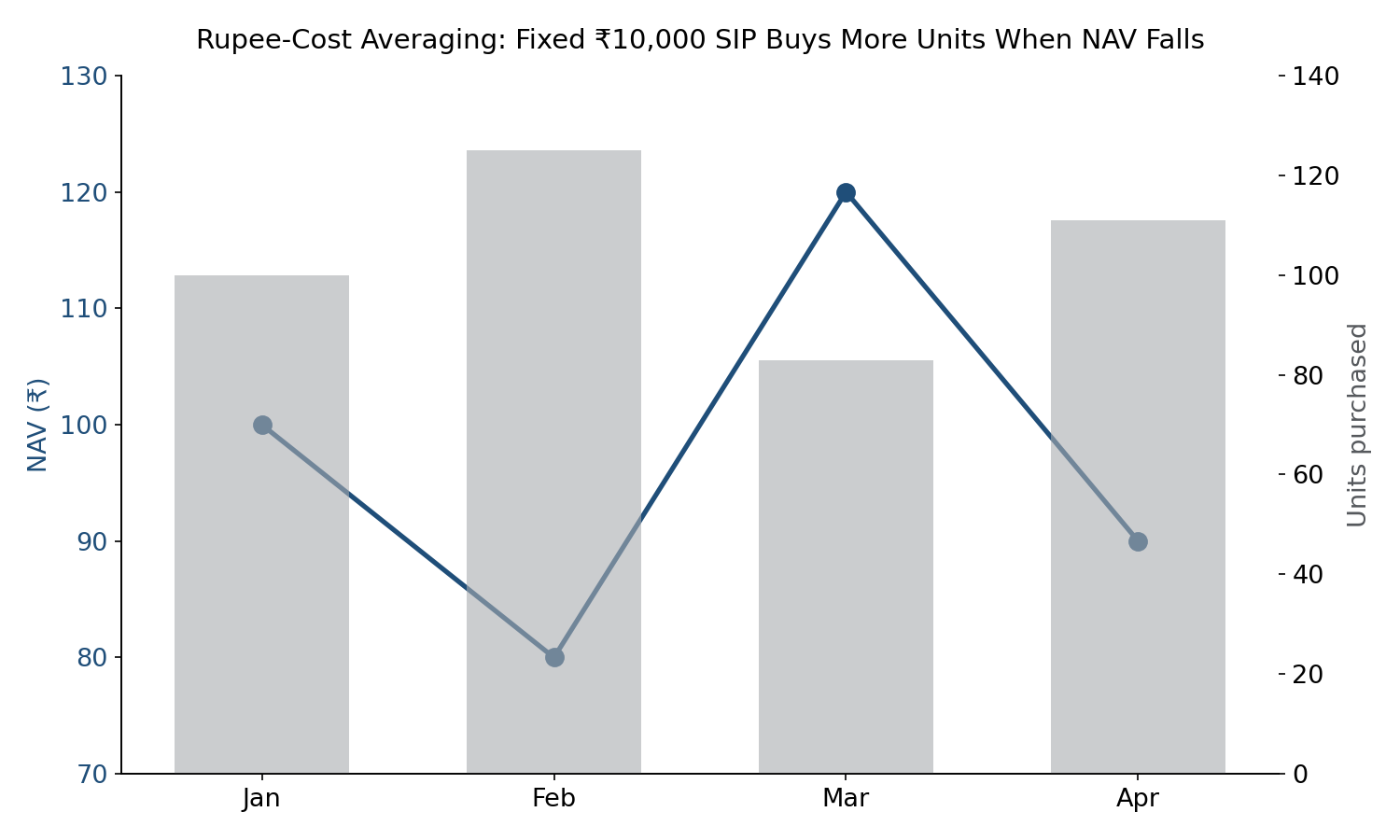
What this does: it lowers your average buying price over time. What it does not do: protect the units you already own if the market falls after you bought them. SIP is a way of buying — not a shield against losses.
When SIP wins, and when lump sum wins
SIP tends to win when: you invest near a market top, or the market stays flat or choppy for years. Think of 2008 — someone who put in a lump sum right before the crash took years to recover. Someone doing SIP kept buying cheaper units on the way down and bounced back faster.
Lump sum tends to win when: the market is trending up. Someone who invested a lump sum right after the 2020 crash rode the entire recovery. A SIP spreading that same money over 24 months would have kept a chunk sitting idle while the market climbed.
| SIP | Lump sum | |
|---|---|---|
| Works best when | Market is falling or flat | Market is rising |
| Best for | Monthly salary or savings | Bonus, or money you already have |
| Risk of bad timing | Low | Higher — your entry point matters more |
| Your money’s exposure | Goes in gradually | Goes in all at once |
Tax rules you should know
Current rules for equity mutual funds (FY 2025-26, unchanged in Budget 2025 and Budget 2026):
- Held over 12 months (LTCG): 12.5% tax on profit above ₹1.25 lakh in a year
- Held 12 months or less (STCG): 20% tax
The SIP catch: every SIP instalment counts as a separate purchase with its own 12-month clock. If you started a SIP 14 months ago and redeem everything today, only your first two instalments get the lower LTCG rate — the rest are taxed as STCG at 20%. A lump sum crosses the 12-month mark on one single date, so it’s simpler to plan around.
This matters most when you’re planning a withdrawal — say, for a house down payment or a child’s education. If you know roughly when you’ll need the money, it’s worth checking which of your SIP instalments will have crossed 12 months by that date, rather than assuming the whole redemption qualifies for the lower LTCG rate.
The middle path: STP (Systematic Transfer Plan)
Have a lump sum but nervous about putting it all in at once? You don’t have to choose between “all in” or “sit in a savings account.” An STP works like this:
- Park the money in a liquid fund (earns roughly 6.5-7%, much better than a savings account) — you can do this through Zerodha Coin or INDMoney, both of which let you set up the automatic transfer in the same app
- Set up an automatic monthly transfer into your chosen equity fund, usually over 6-12 months
- Your money enters the market gradually, while the rest keeps earning something
This won’t beat a lump sum mathematically if markets keep rising — it’s there to help you sleep at night, not to boost returns.
A step-up SIP: the option most beginners skip
If you’re salaried and expect your income to grow, a step-up (or “top-up”) SIP is worth knowing about. Instead of investing a fixed ₹10,000 every month forever, you increase the amount automatically each year — say, by 10%, matching a typical annual raise.
Here’s why this matters more than it sounds: someone who starts at ₹10,000/month and never increases it invests roughly ₹36 lakh over 30 years. Someone who steps up by just 10% a year, starting at the same ₹10,000, ends up investing over ₹1.6 crore over the same period — because the instalment grows in step with the salary funding it. Most SIP platforms and AMC apps now let you set this up once, so it runs automatically without you having to remember to increase it manually every year.
This isn’t a SIP-vs-lump-sum question exactly — but if you’ve already decided SIP is right for you (because your money comes from a salary), a step-up SIP is usually a better default than a flat one.
How to actually start one (if you haven’t yet)
- Complete your KYC — most platforms verify this digitally using PAN and Aadhaar in a few minutes. I personally use Zerodha Coin and INDMoney for mutual fund SIPs, and Angel One for direct stock investing — all three support both SIP and lump sum from the same app.
- Pick a fund that matches your goal and risk appetite — don’t pick based on last year’s returns alone.
- Choose SIP or lump sum, and set the amount and date.
- Set up auto-debit (NACH mandate) from your bank account so the SIP runs without manual action each month.
- Review once or twice a year — not every week. Checking daily tends to trigger exactly the panic-selling behavior SIP is meant to avoid.
You can pause or stop a SIP at any time with no penalty from the fund house (though check if your specific platform charges anything). This flexibility is one more reason SIP suits money you’re not 100% sure about committing to for the long haul.
(Disclosure: the Zerodha, Angel One, and INDMoney links above are referral links — I may earn a small commission at no extra cost to you if you sign up through them. Full disclosure on the Disclaimer page.)
4 questions to help you decide
- Is the money with you today, or coming in gradually? Gradual → SIP fits naturally. Already with you → move to the next question.
- Will you need this money soon? If yes, your timeline matters more than SIP vs lump sum — you may not want equity at all.
- Can you handle watching your money drop 15-20% right after investing? If that would make you panic, split the investment or use an STP.
- Are you waiting for the “perfect” time to invest? Be honest — waiting forever is still a decision, and it has a real cost.
So, which one actually wins?
If your money comes from your salary — invest it every month. That’s exactly what SIP is for, and the habit matters more than any study.
If you already have a lump sum for a long-term goal (10+ years) and can handle some ups and downs — investing it sooner usually works out better, because your money gets more time to grow.
If neither feels comfortable — split the difference with a short STP instead of letting the money sit idle.
Read next: If you haven’t decided what to invest in yet, read Mutual Fund Sahi Hai? Or Is an Index Fund Better? — it covers active vs passive funds, which this post assumes you’ve already thought about. If you’re worried about a market drop before you can even get invested, our guide on financially preparing for AI-driven job cuts covers building the emergency fund you should have before either SIP or lump sum. And if tax rules for FY 2025-26 also affect your other income, our Union Budget 2026 complete guide covers the full picture.
FAQ
Is SIP better than lump sum? Not always. If money comes in gradually, SIP fits your cash flow. If you already have a large amount, investing it sooner usually gives it more time to grow — but it’s also exposed to the market right away.
Does SIP protect me from losses? No. AMFI is clear that rupee-cost averaging doesn’t guarantee profit or protect you from losses in a falling market.
Is SIP taxed differently from lump sum? No, the tax rates are the same. The only difference is that each SIP instalment has its own 12-month clock, so one redemption can mix short-term and long-term gains. A lump sum doesn’t have this problem.
What is the minimum amount to start a SIP? Most funds allow ₹500 a month, and some allow as low as ₹100. SEBI has also been encouraging a ₹250 “Chhoti SIP” option aimed at first-time investors.
Can I stop or pause my SIP anytime? Yes. There’s usually no penalty from the fund house for pausing or stopping a SIP, though it’s worth checking your specific investing app for any platform-level charges.
What’s a step-up SIP, and should I use one? It’s a SIP that automatically increases your instalment each year, usually in line with your salary growth. If you’re investing from a salary that grows over time, it’s generally a better default than a flat SIP amount.
I got a ₹3 lakh bonus. Should I do SIP or invest it all at once? If it’s genuinely long-term money, investing it sooner is worth considering. If putting it all in at once feels too risky, split it into 2-4 parts over 2-3 months, or use an STP.
Should I wait for the market to fall before investing? There’s no reliable way to know when or how much the market will fall. Waiting indefinitely is also a choice — and it has its own cost.
Disclaimer
This article is for general education only and is not personal investment, financial, or tax advice. I am not a SEBI-registered investment adviser. Mutual fund investments are subject to market risk, including possible loss of the amount invested. Past performance does not guarantee future results. Tax rules can change — check the latest rules with the Income Tax Department or a qualified CA before making decisions.
Sources: SEBI investor material on SIP and rupee-cost averaging, AMFI investor guidance on SIP, AMFI’s August 2026 monthly SIP data, CBDT’s official FAQ on the FY2024 capital gains rate changes (via PIB), Income Tax Department’s live capital gains reference page, Business Standard on SEBI’s Chhoti SIP initiative, and a Nifty 50 rolling-return backtest (2002-2025) used for directional context only.