
Mutual Fund Sahi Hai? Or Is an Index Fund Better?
84% of large-cap active funds in India failed to beat their own benchmark over 10 years. That’s not a hot take — it’s S&P’s own scorecard. I’ll show you the exact numbers below.
“Mutual Fund Sahi Hai.” You’ve heard that line more times than you can count — on TV, on YouTube pre-rolls, maybe from a relative who “does SIPs.” It’s a good campaign. It got an entire country investing instead of only buying gold and fixed deposits.
But it leaves out one detail. It says mutual fund, not which kind. And that turns out to matter more than the ad ever explains.
There are really two different products hiding under that one friendly slogan. One has a human fund manager actively trying to beat the market. The other doesn’t try to beat anything — it just buys the market and rides along. Someone will tell you to “just buy an index fund.” Someone else will insist on “a good fund with a proven manager.” Both sound confident. Both can’t be fully right.
I teach optimization for a living, so numbers-over-opinions is basically my whole personality. Good news: this one doesn’t need opinions. There’s real, published data on how these two approaches have actually performed in India. I’ve pulled it together here in plain language, whether this is your first investment ever or your fifteenth.
The one-line version, if you’re in a hurry: an actively managed mutual fund has a manager picking stocks, trying to beat a benchmark like the Nifty 50. An index fund skips that — it just buys the benchmark itself. One tries to win; the other rides along. The rest of this article is which approach has actually worked better for Indian investors, in which situations, and how to actually start either one.

First, the basic difference (explained simply)
A mutual fund — in the way most people use the term — usually means an actively managed fund. A manager and their team pick stocks, time entries and exits, and try to beat a benchmark like the Nifty 50 or Sensex. You’re paying for their judgment.
An index fund is a mutual fund too, technically. But it doesn’t try to beat anything. It just buys all the stocks in an index in the same proportion as the index, and tries to match its return as closely as possible. No stock-picking, no market timing, no manager taking a view.
So really, the comparison isn’t “mutual funds vs. index funds.” It’s active management vs. passive management. Index funds are simply the passive option. I’ll use that framing for the rest of this piece, because it’s the honest one.
The main categories of each
Common actively managed mutual fund categories in India:
| Category | What it invests in | Typical use case |
|---|---|---|
| Large-cap funds | Top 100 companies by market cap | Core, relatively stable holding |
| Mid-cap / Small-cap funds | Companies ranked ~101-250 / below 250 | Higher risk, higher growth potential |
| Flexi-cap / Multi-cap funds | Mix across large, mid, small | Manager’s discretion on allocation |
| ELSS (tax-saving funds) | Mostly equity, 3-year lock-in | Section 80C deduction — but only under the old tax regime, which most salaried taxpayers have now moved away from, so ELSS’s core appeal has faded |
| Sectoral/thematic funds | A single sector (banking, IT, pharma) | Concentrated, higher-risk bets |
| Debt funds | Bonds, government securities | Lower volatility, income-focused |
| Hybrid funds | Mix of equity and debt | Balanced risk profile |
Common index fund categories in India:
| Category | Tracks | Notes |
|---|---|---|
| Nifty 50 / Sensex index funds | Top 50 (or 30) large-cap stocks | Most common starting point |
| Nifty Next 50 index funds | Companies just outside the Nifty 50 | Higher growth, higher volatility |
| Nifty Total Market / Nifty 500 funds | Broader market (500 stocks) | Wider diversification |
| Sectoral index funds | A single index sector (e.g. Nifty Bank) | Passive but still concentrated risk |
| International index funds | S&P 500, Nasdaq 100, etc. | Currency + geographic diversification |
| Debt index funds | Government bond indices (e.g. Bharat Bond) | Passive fixed-income exposure |
Notice that index funds now exist across nearly every category active funds do — including sector and international exposure. “Index fund” no longer just means “Nifty 50 fund,” though that’s still the most common entry point for first-time investors.
The cost gap is bigger than it looks
A 1-2 percentage point fee gap. That’s the whole story here. Let me show you why it matters more than it sounds like it should.
Typical direct-plan expense ratios in India today:
| Fund type | Typical expense ratio (direct plan) | Example |
|---|---|---|
| Nifty 50 index fund (low-cost) | 0.06%–0.10% | Navi, Bandhan |
| Nifty 50 index fund (established AMC) | 0.15%–0.20% | UTI, HDFC, ICICI Prudential, SBI |
| Actively managed large-cap fund | ~1.0%–1.5% (SEBI-mandated TER ceiling, varies by AUM slab) | Category average |
| Actively managed mid-cap/small-cap fund | ~1.5%–2.25% (SEBI-mandated TER ceiling, varies by AUM slab) | Category average |
That gap doesn’t sound dramatic year to year. It becomes dramatic over 20-30 years. Expense ratios come off your returns every single year, compounding against you the whole time.
For example: a ₹10,000/month SIP over 25 years, one going into an active fund, the other an index fund. (This math holds whether the index fund tracks the Nifty 50, the Sensex, or another large-cap index — the fee gap is the driver, not the specific index.)
| Active fund (net ~10.5%/yr, after ~1.3% fees) | Index fund (net ~12%/yr, after ~0.2% fees) | |
|---|---|---|
| Monthly SIP | ₹10,000 | ₹10,000 |
| Total invested (25 yrs) | ₹30,00,000 | ₹30,00,000 |
| Approx. final corpus* | ~₹1.46 crore | ~₹1.90 crore |
| Gap vs. index fund | −₹44 lakh | — |
*Illustrative only — assumes the stated annual returns hold steady for 25 years, which real markets never do. The point isn’t the exact rupee figure; it’s that a ~1.5 percentage point fee/return gap, compounded over decades, is a genuinely large number — not a rounding error.

Both fund types face identical taxation on the way out (covered below), so this gap is purely a fees-and-returns story, not a tax story. The lesson isn’t “index funds always win.” It’s “an active fund has to overcome that fee gap through genuine outperformance before it’s actually ahead of you” — which brings us to whether they actually do.
Do Indian fund managers actually clear that bar?
Most comparison articles skip this part. It’s the part that actually matters.
S&P Dow Jones Indices runs the SPIVA India Scorecard twice a year — actively managed Indian funds against their actual benchmarks, not cherry-picked ones. Here’s Year-End 2025, how often active funds failed to beat their benchmark:
| Fund category | 1-year | 3-year | 5-year | 10-year |
|---|---|---|---|---|
| Indian Equity Large-Cap | 75.0% | 74.2% | 84.4% | 76.3% |
| Indian ELSS (tax-saving) | 69.2% | 55.0% | 58.5% | 82.9% |
| Indian Equity Mid-/Small-Cap | 12.1% | 41.5% | 46.0% | 79.0% |
(Figures show the % of active funds in each category that underperformed their benchmark index. Source: SPIVA India Year-End 2025 Scorecard.)
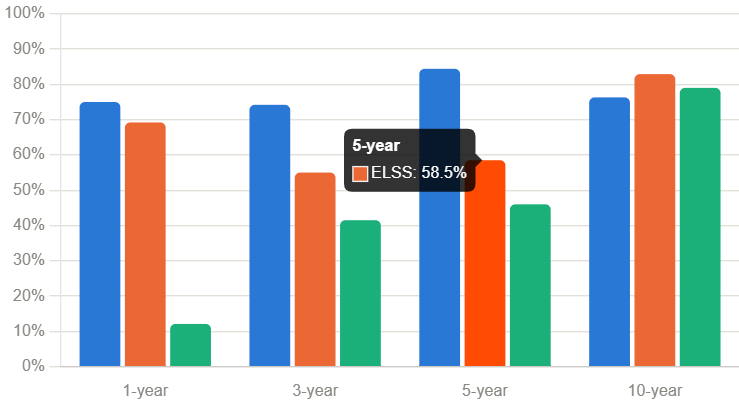
Two things jump out:
- In large-cap, active managers struggle consistently — roughly 3 out of 4 failed to beat the index over both 5 and 10 years.
- In mid-/small-cap, 2025 was an unusually strong year for active managers (just 12% underperformed) — their best relative showing since 2014. But zoom out to 10 years and the pattern converges with large-cap: about 79% still underperformed. Short-term active outperformance in this category doesn’t reliably hold up over the long run.
So the “index always wins” claim isn’t universally true. It holds most strongly in large-cap, less so in mid/small-cap, where skilled stock-picking — and access to less-followed companies — can genuinely add value in some years.
A quick honesty check: SPIVA has critics too. Some researchers argue it understates active manager skill by not accounting for fund closures and asset-weighting. It’s not gospel. But it’s the most consistent, apples-to-apples dataset available for India, and that’s a far better starting point than a fund’s own marketing brochure.
What about taxes? (This part is identical, which surprises people)
This part gets simple, and it surprises people. As of the current capital gains rules under the Income Tax Act (unchanged through Budget 2026), both fund types are taxed identically, since both count as “equity-oriented” schemes (funds holding at least 65% in domestic equity):
| Active equity mutual fund | Equity index fund | |
|---|---|---|
| Holding period for LTCG | Over 12 months | Over 12 months |
| STCG rate (≤12 months) | 20% flat | 20% flat |
| LTCG rate (>12 months) | 12.5% | 12.5% |
| Annual LTCG exemption | ₹1.25 lakh | ₹1.25 lakh |
| Indexation benefit | None | None |
For example, say you invest ₹5,00,000 as a lump sum and redeem it after 14 months at ₹7,50,000 — a gain of ₹2,50,000, held long enough to qualify as LTCG. The first ₹1,25,000 of that gain is exempt. Tax applies only to the remaining ₹1,25,000, at 12.5% = ₹15,625 (plus applicable cess). This calculation is exactly the same whether that ₹5,00,000 sat in an active fund or an index fund — the only variable that changes your final take-home is which one grew faster after fees, not the tax bill.
So taxation isn’t a reason to pick one over the other — it’s identical either way. The expense ratio and the actual return you get to keep after fees are where the real difference sits.
So which one should you actually pick?
Genuinely, it depends where in the market you’re investing. That’s the honest, non-generic answer — and it’s also how I’ve allocated my own core holdings, for what it’s worth:
Lean toward index funds when:
- You’re investing in large-cap territory (Nifty 50, Sensex, Nifty Next 50) — this is where active managers have struggled hardest to beat the benchmark, per the SPIVA data above.
- You want a “set it and forget it” core holding without needing to track whether your fund manager is still good, still there, or still following the same strategy.
- You’re cost-sensitive and investing for a genuinely long horizon (15+ years), where fee drag compounds the most.
Active funds can still make sense when:
- You’re investing in the mid-cap/small-cap space, where skilled managers have shown a real, data-backed edge recently — this is a less efficient, less-followed part of the market.
- You specifically want a manager who can move to cash or shift sectors during volatility (index funds can’t do this — they’re always fully invested per the index rules).
- You’ve done the work to identify a fund with a genuinely long, consistent track record — not just a good trailing-3-year number, which is often just a fund riding a sector tailwind.
A very common, sensible middle ground: use a Nifty 50 or Sensex index fund as your large-cap “core,” and if you want to chase alpha, do it through a well-researched mid-cap or flexi-cap active fund on the side — rather than picking an active large-cap fund that’s statistically unlikely to earn its higher fee.
A note on picking a specific index fund
Nifty 50 index funds are the most common entry point, and most of the examples above use one — but the same logic applies whether you’re choosing among Nifty 50, Sensex, Nifty Next 50, or Nifty 500 index funds. Within any single index, nearly every fund tracking it — from UTI, HDFC, ICICI Prudential, SBI, or newer entrants like Navi or Bandhan — owns the exact same underlying stocks in the exact same weights. Their pre-cost returns are, by definition, nearly identical. The only things that actually differentiate them are:
- Expense ratio (lower is better, all else equal)
- Tracking error — how closely the fund’s actual return matches the index’s return (again, lower is better)
- Direct vs. Regular plan — always pick Direct. Regular plans bake in a distributor commission that quietly compounds against you for the life of the investment; this single choice usually matters more than which AMC you pick.
There’s no “best” fund in the sense of a hidden gem within a given index — it’s mostly a search for the cheapest, best-tracking Direct plan for whichever index you’ve chosen, not a stock-picking decision.
Where do you actually open an account and start?
If you’re completely new to this, you’ll need a demat + investment account before you can buy either a mutual fund or an index fund. A few platforms make this genuinely simple for first-time investors:

- Zerodha — India’s largest broker by active users; good for buying index fund units directly (via Coin) or ETFs, with a clean, beginner-friendly interface.
- Angel One — full-service broker with strong mobile-first tools, useful if you also want to explore direct stock investing alongside mutual funds later.
- INDmoney — a good all-in-one option if you want mutual funds, US stocks, and net-worth tracking in a single app, especially useful for salaried professionals who want a consolidated view.
Disclosure: the links above are referral/affiliate links — if you sign up through them, CHANDRAS EDU may earn a small commission at no extra cost to you. This doesn’t influence which platform or fund category we recommend; the comparisons and data in this article are independent of any partnership.
Whichever platform you pick, the decision covered in this article — active vs. index, and which category — doesn’t change. The platform’s just the door you walk through.
A quick disclaimer, because this matters: this article is for educational purposes only and is not personalised investment advice. Mutual fund investments are subject to market risk, including the possible loss of principal — please read all scheme-related documents carefully before investing. Past performance (including the SPIVA data cited above) is not indicative of future results. CHANDRAS EDU is not a SEBI-registered investment adviser; consider speaking with one before making decisions specific to your financial situation. Some links in this article are affiliate/referral links, disclosed above, and do not affect the impartiality of the comparisons made.
Related reading on CHANDRAS EDU:
- SIP vs. lump sum investing: which strategy actually wins? (coming soon)
- Gold investment comparison: SGBs vs. digital gold vs. physical gold (coming soon)
- Top 5 Nifty 50 index funds in India, compared (coming soon)
- ETFs vs. mutual funds: which is right for you? (coming soon)
- Direct stock investing vs. investing through mutual funds/index funds (coming soon)
FAQs
Are index funds risk-free? No. They carry full market risk — if the Nifty 50 falls 20%, your index fund falls roughly 20% too. “Passive” refers to management style, not risk level.
Can an index fund ever underperform its own index? Yes, slightly — this is called tracking error, caused by the fund’s expense ratio and minor cash-drag effects. It’s usually small (well under 0.1–0.2% a year for a well-run fund) but it’s why tracking error is worth checking before you invest.
Is a Nifty 50 index fund enough on its own? For many first-time investors, yes, as a starting core holding. As your portfolio and goals get more specific, you may want to layer in mid-cap, international, or debt exposure — but that’s a separate decision from active-vs-passive.
I’m a complete beginner — where do I literally start? Open an account on any SEBI-registered platform (a few options are listed above), complete KYC, and start a small SIP — even ₹500–1,000/month — in a Direct-plan Nifty 50 index fund while you learn. You can always add complexity later; starting small and consistent beats waiting for the “perfect” first investment.
Sources: SPIVA® India Year-End 2025 Scorecard (S&P Dow Jones Indices, data as of Dec 31, 2025); Income Tax Act provisions on equity capital gains post Union Budget 2024 (rates unchanged through Budget 2026); publicly disclosed expense ratios of UTI, HDFC, ICICI Prudential, SBI, and Navi Nifty 50 Index Funds (direct plans) as reported in industry coverage, 2026.