
FII Selling Hits ₹44,000 Cr: What It Means for Your SIP
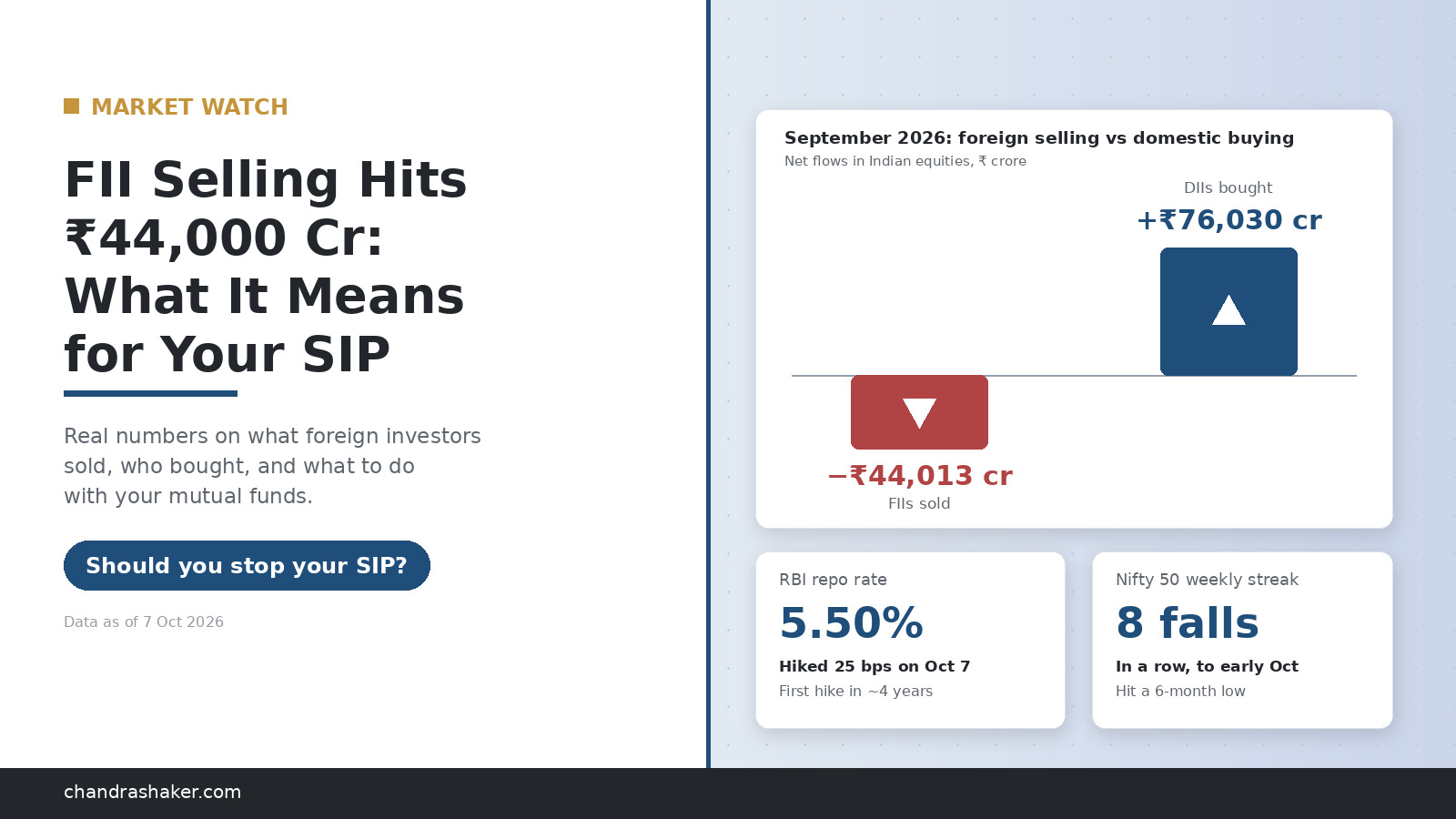
Foreign investors sold ₹44,013 crore of Indian shares in September. On October 7, the RBI raised interest rates for the first time in nearly four years. The Nifty 50 fell for eight weeks in a row through last week.
If you have a SIP running, you have probably asked yourself one question this week: should I stop it?
This post explains what is actually happening, in simple language, using real numbers from published sources. It also covers what it means for your mutual funds, and what you can calmly do about it. All data is as of October 7, 2026, and it changes daily.
Quick answer: what should a SIP investor do?
| Your situation | What generally makes sense |
|---|---|
| Your SIP is for a goal 5+ years away | Keep it running. A falling market is when SIP buys more units. |
| You need this money within 1-2 years | This is a time-horizon question, not a market question. Equity may not suit short deadlines. |
| You have no emergency fund | Build that first, before adding to any investment. |
| You are waiting for the “bottom” to invest | Nobody can call it. Waiting is also a bet. |
| All your savings are in Indian equity | Check if one-country concentration matches your risk comfort. |
The word to notice is generally. Nothing here is a guarantee, and nobody knows what the market does next.
What the numbers say right now
| Indicator | Latest figure |
|---|---|
| Nifty 50 | Closed at 22,421.95 on Oct 1, after touching a six-month low that week. Down nearly 13% in 2026 (to end-September). Fell for 8 straight weeks. |
| FII net selling, September | ₹44,013 crore. Net sellers in 16 of 21 sessions. |
| FII net selling, 2026 so far | About ₹4.03 lakh crore (to end-September) |
| DII net buying, September | ₹76,030 crore. Net buyers on every session. |
| Rupee | About ₹96 per US dollar |
| Crude oil (Brent) | Around $100 a barrel |
| RBI repo rate | Raised by 0.25 percentage points to 5.50% on Oct 7 |
Two terms, in plain words: FII means foreign institutional investors: overseas funds that buy Indian shares. SEBI calls them FPIs, but the media still says FII. DII means domestic institutional investors: Indian mutual funds, insurers and pension funds.
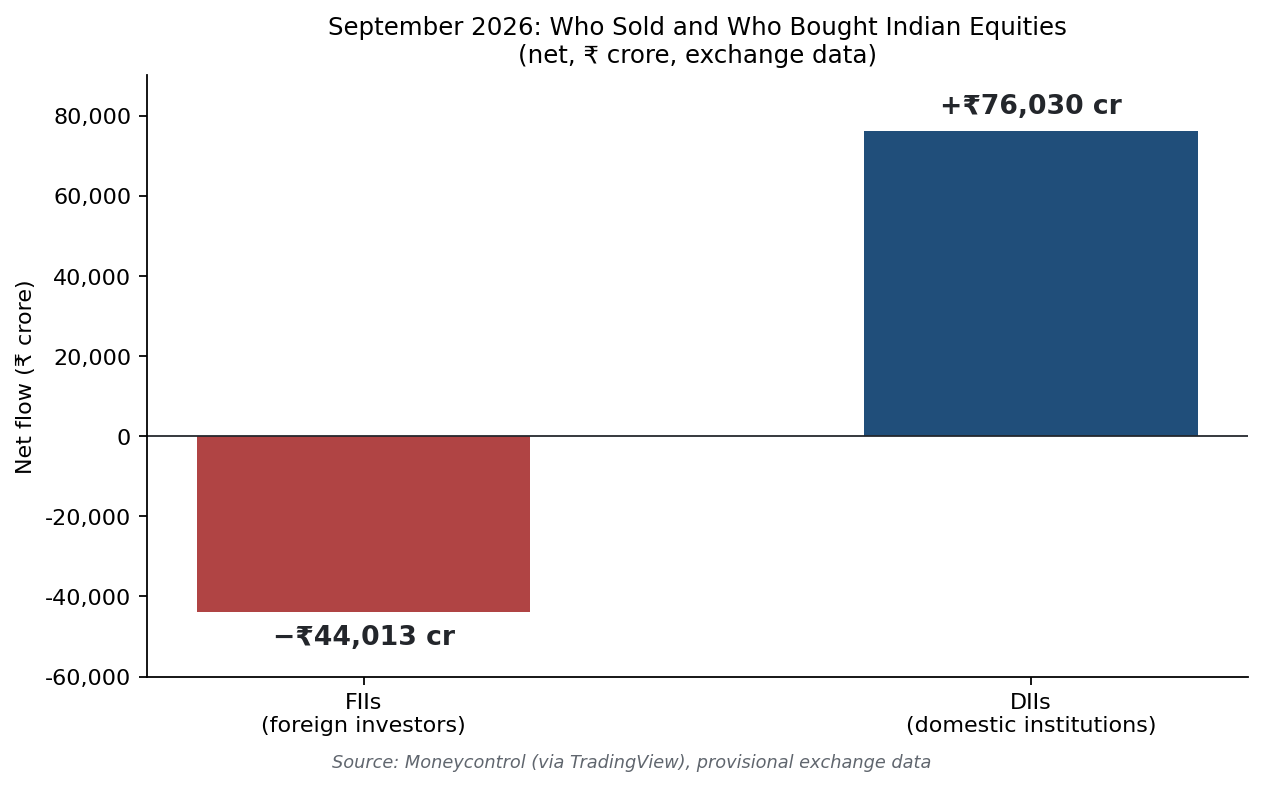
A note on the data. Different trackers report slightly different totals, because they use different sources and cut-off dates. The figures above use provisional exchange data, as reported by Moneycontrol. One tally based on NSDL-linked data puts September closer to ₹35,860 crore, and 2026 so far above ₹3.05 lakh crore. The direction is the same in every data set: foreign investors have been heavy net sellers.
The two sides: foreign selling, domestic buying
Look at the chart again. While FIIs sold ₹44,013 crore in September, DIIs bought ₹76,030 crore. Domestic institutions were net buyers on every single trading day of the month, and their buying was bigger than the foreign selling.
That is why the Nifty has fallen, but not collapsed.
Where does domestic institutions’ money come from? Partly from you. Mutual funds are DIIs, and SIP contributions are a steady source of their cash. AMFI data shows SIP contributions hit a record ₹32,297 crore in August 2026. When your SIP instalment goes through, it joins the buying that is cushioning this fall.
Foreign selling did speed up at the end of September. Nearly two-thirds of the month’s total, about ₹29,175 crore, came in just the last four sessions. September 30 alone saw ₹10,148 crore of foreign selling, the biggest single day since March 23.
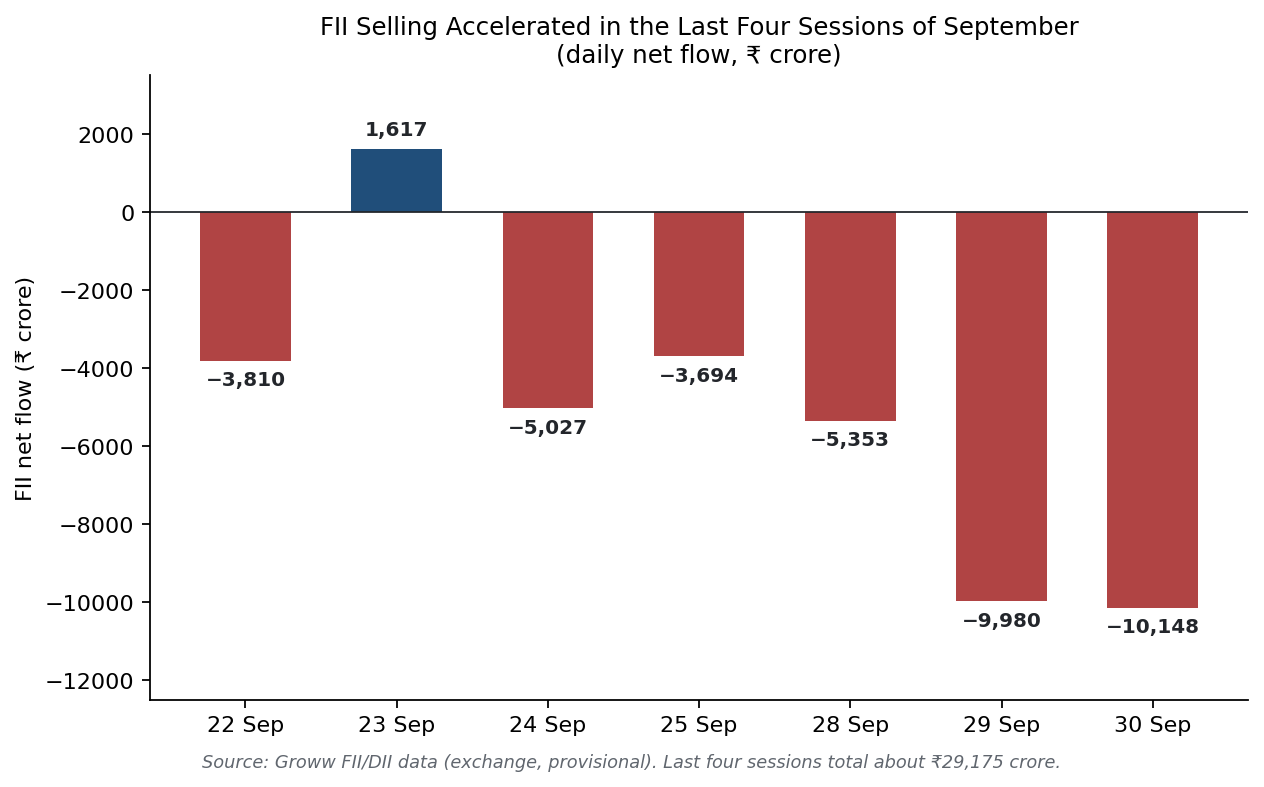
The selling continued into October. On October 6, FIIs sold another ₹2,961 crore.
Why are foreign investors selling Indian stocks?
No single reason explains it. Market reports point to a mix of four pressures:
- Higher global interest rates. When safer US bonds pay more, global funds have less reason to take risk in markets like India.
- Crude oil near $100. India imports most of its oil. Costlier crude can push up inflation, squeeze company profit margins and widen the trade deficit.
- A weak rupee. A foreign investor earns in dollars. If the rupee falls, the same Indian shares are worth fewer dollars, which makes selling more tempting. Selling shares also means converting rupees into dollars, which can weigh on the rupee further. This loop can feed itself.
- Doubts about earnings. Analysts expect slow earnings growth as the quarterly results season begins. TCS reports on October 8, HCLTech on October 12 and Infosys on October 23.
The sectors matter too. NSDL’s fortnightly data for September 1-15 showed financial services as the sector with the largest foreign outflow, about ₹6,200 crore. Financial stocks carry a heavy weight in the Nifty 50, so heavy selling there pulls the index down.
What the RBI rate hike means
On October 7, the RBI raised the repo rate by 25 basis points to 5.50%. The repo rate is the rate at which the RBI lends to banks. A basis point is one-hundredth of a percentage point, so 25 basis points is 0.25%.
This is the first hike in nearly four years. The RBI had cut rates by a total of 1.25 percentage points during 2025, taking the repo rate to 5.25%. It has now changed its stance to “calibrated tightening” and said rate cuts are off the table for now.
What does this mean for you?
- Loans: Home and car loan rates can rise over time as banks pass the increase on.
- Equity funds: Higher rates can put pressure on share valuations, because safer returns look more attractive.
- Debt funds: When interest rates rise, the prices of existing bonds tend to fall. Funds holding longer-term bonds can see their NAV (net asset value, the price of one unit) dip. Liquid and short-term funds are usually less affected.
Rate hikes can also help the rupee, since higher rates make holding rupee assets more attractive. How much, and for how long, is hard to say.
How FII selling affects your mutual funds
Here is the simple chain:
- A mutual fund owns shares of many companies.
- When foreign investors sell large shares, those prices fall.
- The fund’s NAV is the value of everything it holds, divided by the number of units. When share prices fall, the NAV falls.
This hits large-cap funds and Nifty 50 index funds directly, since foreign investors tend to hold a lot of large-company shares. It does not mean your fund is badly managed. It means the whole market is moving.
Your units are unchanged. If you hold 1,000 units, you still hold 1,000 units. Only the price per unit has moved.
For more on choosing between active and index funds, read Mutual Fund Sahi Hai? Or Is an Index Fund Better?
What SIP does in a falling market (and what it doesn’t)
A SIP invests a fixed amount every month. When prices fall, the same amount buys more units. This is called rupee-cost averaging.
Here is a simple illustration. These NAVs are made up to show the idea. They are not a real fund and not a forecast.
| Month | NAV | SIP amount | Units bought |
|---|---|---|---|
| 1 | ₹100 | ₹10,000 | 100.00 |
| 2 | ₹90 | ₹10,000 | 111.11 |
| 3 | ₹85 | ₹10,000 | 117.65 |
| 4 | ₹95 | ₹10,000 | 105.26 |
You invested ₹40,000 and now own about 434 units. Your average cost per unit is about ₹92.16. At a NAV of ₹95, your units are worth about ₹41,232. You are slightly ahead, even though the NAV ended below its starting point of ₹100.
Compare that with someone who put all ₹40,000 in at ₹100 in month 1. They own 400 units, worth ₹38,000 at a NAV of ₹95.
Now the honest part. SIP does not guarantee a profit and does not protect you from losses in a falling market. AMFI states this clearly. Your existing units still lose value when the market falls. In a market that only goes up, a lump sum would have done better. I compared both in SIP vs Lump Sum: Which One Really Wins in India?, using 23 years of Nifty data.
Mistakes to avoid in a falling market
- Stopping your SIP out of fear. Stopping means you skip the months when units are cheapest. If your goal is far away, the reasons you started are probably unchanged.
- Waiting for the bottom. It is only visible in hindsight. People who wait often miss the recovery too.
- Checking your portfolio every day. Daily swings create anxiety, not information. A monthly or quarterly review is enough.
- Selling money you need soon. If a bill or a goal is within a year or two, that money should not depend on today’s market.
- Treating one-day news as a trend. Today’s market move tells you little about the next five years.
A calm checklist
- Emergency fund first. Keep about six months of expenses outside the stock market, in a savings account or liquid fund. This stops you from being forced to sell shares at a bad time. If your job is a worry, my post on financial preparation for AI-driven IT job cuts covers this.
- Match money to deadlines. Money needed within about three years does not belong fully in equity.
- Keep SIPs automated. Automation removes the daily decision. If you are starting or restarting one, I use Zerodha Coin and INDmoney for mutual fund SIPs, and Angel One also offers them. Check each platform’s charges and fund choice before you decide.
- Check concentration. Add up how much of your savings sits in Indian equity alone, including your EPF and any property or company stock. One country can have a bad stretch.
- Review on a schedule, not on a headline.
Where global investing fits
Over the last two years, the Nifty 50 delivered a total return (including dividends) of about −1.9% a year, measured from September 2024 to mid-September 2026, before the latest fall. A 5-year Nifty index fund (the UTI Nifty 50 Index Fund) delivered about 6.9% a year. I compared this with S&P 500 funds in my post on UCITS ETFs now on INDmoney.
There is also the rupee. It has moved from roughly ₹74 per dollar five years ago to about ₹96 today. For an Indian investor holding dollar-denominated assets, that move added to the rupee value of those assets. This is not guaranteed to continue, and it can reverse. US markets can also fall, and global investing adds currency risk of its own.
If you want to learn how to invest outside India, these two posts explain the routes, the fees and the tax rules:
- How to Invest in US Stocks from India: The Complete Guide
- UCITS ETFs from India: What They Are, and Why They’re Now on INDmoney
I use INDmoney for global investing, and Zerodha and Angel One for direct stock investing in India. How much, if anything, to hold outside India, or in individual stocks, is a personal decision that depends on your goals and risk comfort.
(Disclosure: the INDmoney, Zerodha and Angel One links in this post are referral links. I may earn a small commission at no extra cost to you if you sign up through them. See the Disclaimer page.)
What to watch next
- Quarterly results: TCS on October 8, HCLTech on October 12, Wipro and Tech Mahindra on October 15, Infosys on October 23.
- Daily FII and DII data: whether foreign selling slows or continues.
- The rupee and crude oil: both have been key pressure points.
- RBI commentary: the central bank has said future moves can only be a hike or a pause.
Nobody can say when this phase ends. What you can control is your plan: your emergency fund, your time horizon, and whether your SIP keeps running.
FAQ
Why are FIIs selling Indian stocks? Reports point to a mix of high global interest rates, crude oil near $100, a weak rupee and doubts about corporate earnings growth.
What is the difference between FII and DII? FIIs are foreign investors. DIIs are domestic institutions such as mutual funds, insurers and pension funds.
Does FII selling affect my mutual fund? Yes, indirectly. When foreign selling lowers the prices of shares your fund holds, the fund’s NAV falls. The number of units you own does not change.
Should I stop my SIP when FIIs are selling? That depends on your goal and time horizon, and I can’t decide it for you. SIP does not protect against losses, but it buys more units when prices are lower. Money needed within a year or two should not depend on equity at all.
How does an RBI rate hike affect mutual funds? Higher rates can pressure share valuations and can lower the prices of longer-term bonds, so some debt funds may dip. Short-term and liquid funds are usually less affected.
Will the market recover? Nobody can say when. Past recoveries don’t guarantee future ones, and anyone promising a date is guessing.
Disclaimer
This article is for general education only and is not personal investment, financial or tax advice. I am not a SEBI-registered investment adviser. Market figures are as of October 7, 2026, come from the sources listed below, and change quickly. Different data providers report different totals for institutional flows. Mutual fund investments are subject to market risk, including the possible loss of the amount invested. Past performance does not guarantee future results. The SIP example uses made-up NAVs to illustrate a concept and is not a forecast. Foreign investments carry currency risk and country-specific risk, and tax rules, including Schedule FA reporting, can change. Check current rules with a qualified professional before investing.
Sources: Moneycontrol via TradingView: Nifty down nearly 13% in 2026 as September delivers 11% of FIIs’ year-to-date selling · 5paisa: FII selling intensifies in September · 5paisa: Nifty hits 6-month low, October 1 post-market update · Groww: FII and DII data · Forbes India: RBI MPC raises repo rate to 5.5% · HDFC Sky: India VIX, crude and rupee, October 7 · Goodreturns: Market outlook, October 5-9 · Weekly Market Rewind, Sept 28-Oct 4 · Sunday Guardian: Why is the Indian stock market down today · Kotak Neo: IT Q2 FY27 results dates · NSDL sector-wise FII data, Sept 1-15 (via Craytheon) · Multibagg: FPI outflows, NSDL-linked tallies · AMFI investor guidance on SIP · INDmoney: UCITS ETFs vs US-listed ETFs, rupee and return data · Value Research: UTI Nifty 50 Index Fund (Direct)