
Happy Engineer's Day: What Being an Engineer Actually Means Today
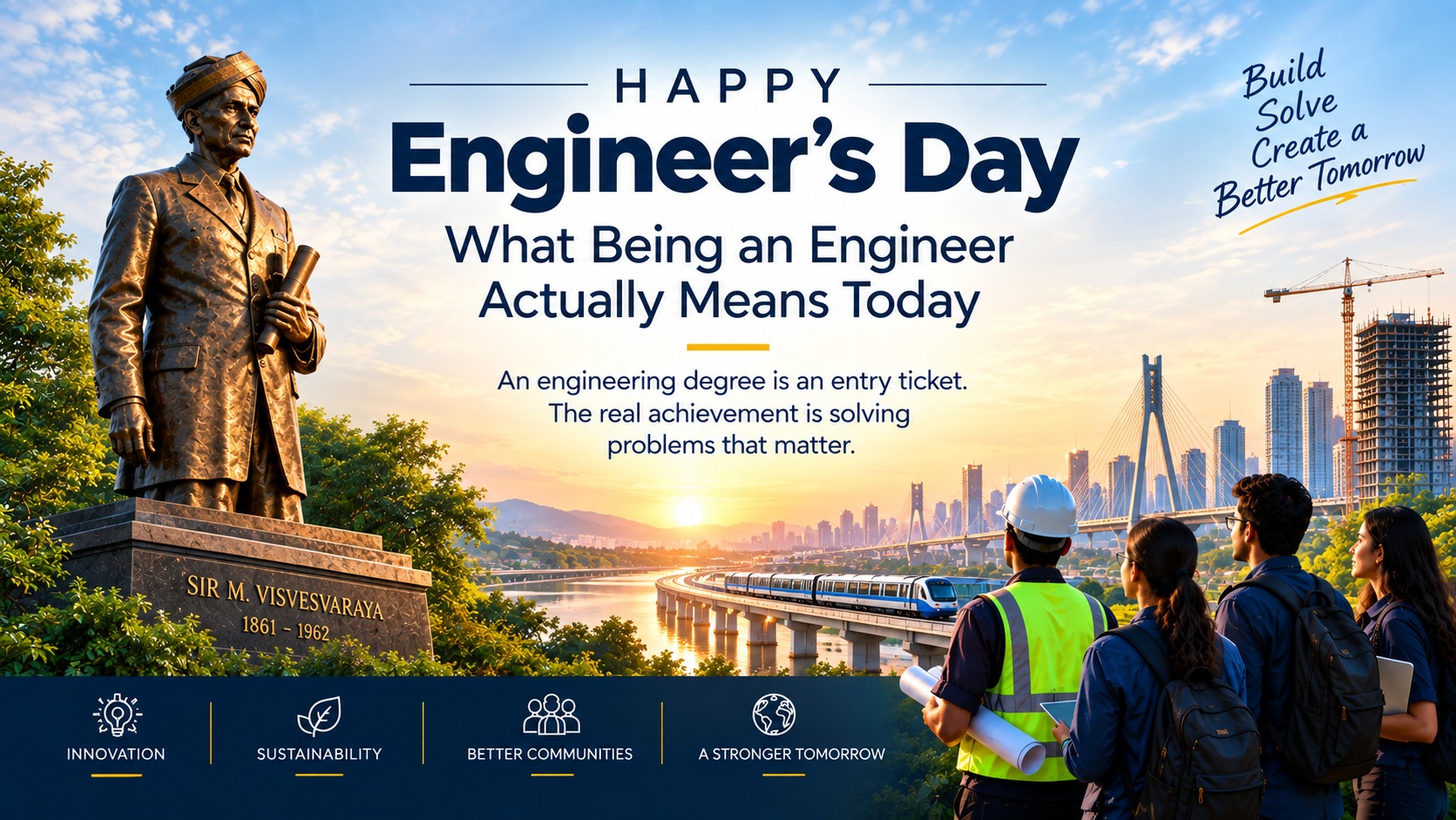
Every September 15th, India remembers Sir M. Visvesvaraya — an engineer whose work still holds up a century later. What made him worth remembering wasn’t a certificate on a wall. It was the ability to look at a genuine, unsolved problem and actually fix it. That’s still the real measure of an engineer, and it’s a standard worth holding on to.
An engineering degree is a ticket, not the destination
Here’s the part students aren’t told clearly enough: an engineering degree gets you through the door. It doesn’t get you the job, and it definitely doesn’t get you to stay in it.
Companies aren’t hiring a certificate. They’re hiring a specific, useful capability — can you actually build the thing, debug the thing, improve the thing, ship the thing. The engineering degree proves you sat through the material. It says nothing about whether you can apply it under real constraints, on a real problem that doesn’t look like the textbook version. The certificate opens the interview. Your skills decide what happens after.
Present-day engineering is genuinely different
The engineering you’re being trained for today isn’t the same field your seniors trained for, even a decade ago. What used to change gradually over several years now shifts within one. The tools change, the expectations change, and even the baseline of what counts as “competent” keeps moving under your feet.
That means the old approach — learn the syllabus, clear the exams, collect the degree, expect the rest to follow — doesn’t hold up the way it used to. What holds up is the ability to keep learning past the point where the formal curriculum stops teaching you anything new. That’s not optional anymore. It’s the actual job.
What hasn’t changed: solving real problems with real skills
And yet, underneath all that change, the core of engineering is exactly what it was in Visvesvaraya’s time: taking a real problem and solving it with skill, not with a title. Dams, bridges, circuits, code, systems — the tools are unrecognizable across a century, but the instinct behind them isn’t. Look at what’s broken or missing. Understand it properly. Build something that actually works.
That’s the part no amount of change in tools or technology touches. It’s also the part that separates someone who merely holds an engineering degree from someone who can genuinely call themselves an engineer.
Hackathons and ideathons reflect the same shift
You can see this shift happening in real time at student hackathons and ideathons. They’ve moved away from being about who can build the flashiest demo, toward who can actually identify a real problem and solve it end to end — a genuine constraint, a genuine user, a working solution, not just a slide deck. Events like Smart India Hackathon reward exactly that instinct: teams that go looking for a real problem worth solving, not teams reciting syllabus material back at a panel. I wrote about this in more detail after mentoring a national-winning SIH team — read that here if you want to see what that process actually looks like from the inside.
This is also where the engineering-degree-as-ticket idea shows up most clearly. Nobody at a hackathon cares which college is on your ID card. They care whether you can build the thing.
What to actually do with this, today
If you’re early in your engineering education, treat the degree as the entry ticket it is — not the finish line. What you build around it, the skills you actually develop and the problems you actually chase down, is what decides whether you’ll have something real to show for it later.
Happy Engineer’s Day. Visvesvaraya solved real problems with real skill — that’s still the standard.
Read next: If you’re wondering which specific skills actually hold up in this environment, 5 Skills AI Cannot Replace: Career Survival Guide for 2026 Freshers covers exactly that. Curious what a genuinely new-shaped engineering role looks like right now? Forward Deployed Engineer: The AI Job Everyone’s Suddenly Hiring For is a good next read. And if today’s reflection on what actually matters resonates, Teachers in the Age of AI makes a similar case from the other side of the classroom. And if you’re a teacher, lab assistant or office staff member wondering where to start with AI, my free AI Tools for Everyday Work course is a no-coding place to begin.
Written on Engineer’s Day 2026, in honor of Sir M. Visvesvaraya.