Finance

FII Selling Hits ₹44,000 Cr: What It Means for Your SIP

FII Selling Hits ₹44,000 Cr: What It Means for Your SIP

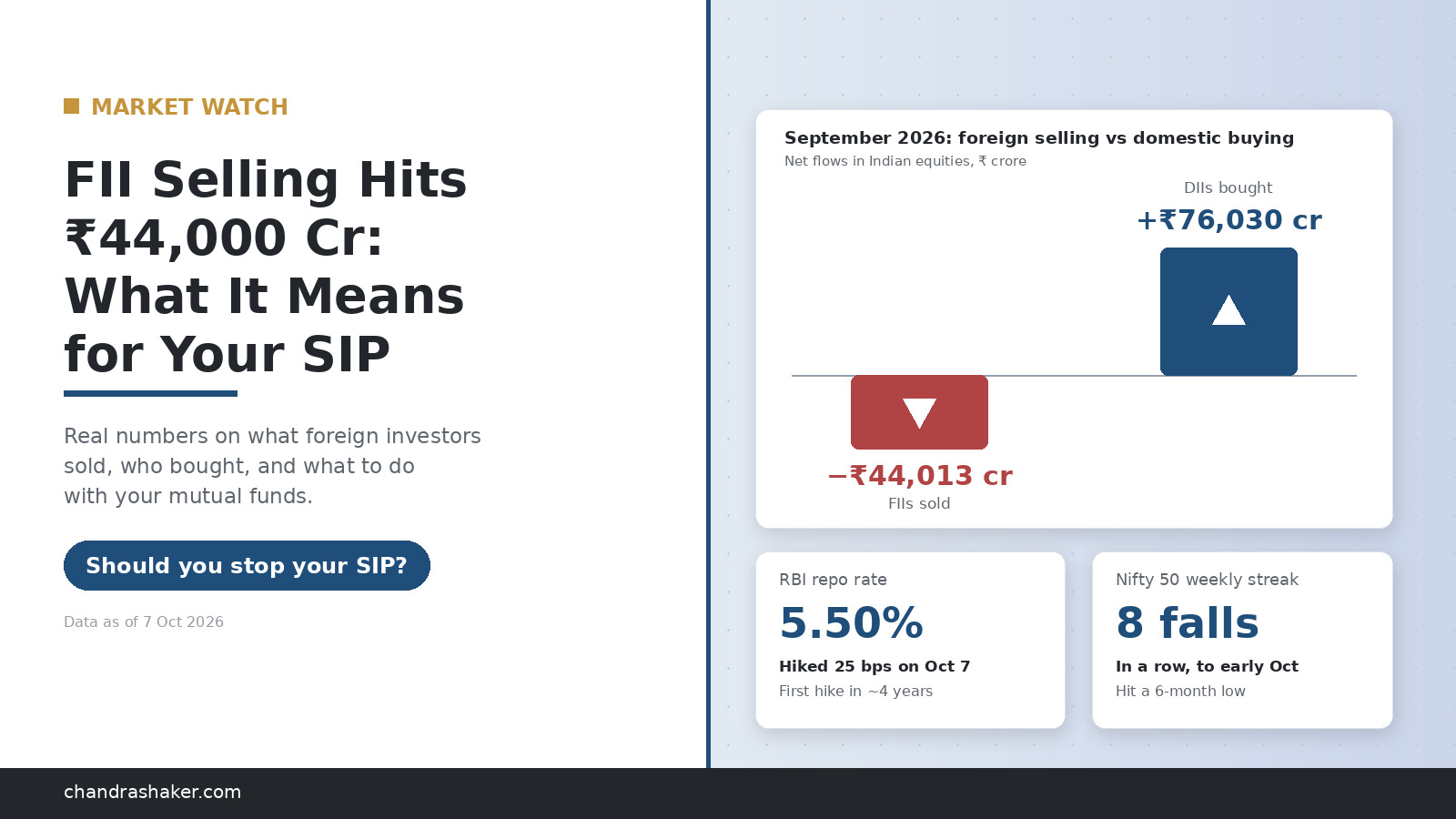
Foreign investors sold ₹44,013 crore of Indian shares in September. On October 7, the RBI raised interest rates for the first time in nearly four years. The Nifty 50 fell for eight weeks in a row through last week.

If you have a SIP running, you have probably asked yourself one question this week: should I stop it?

This post explains what is actually happening, in simple language, using real numbers from published sources. It also covers what it means for your mutual funds, and what you can calmly do about it. All data is as of October 7, 2026, and it changes daily.

UCITS ETFs from India: What They Are, and Why They're Now on INDmoney

UCITS ETFs from India: What They Are, and Why They're Now on INDmoney

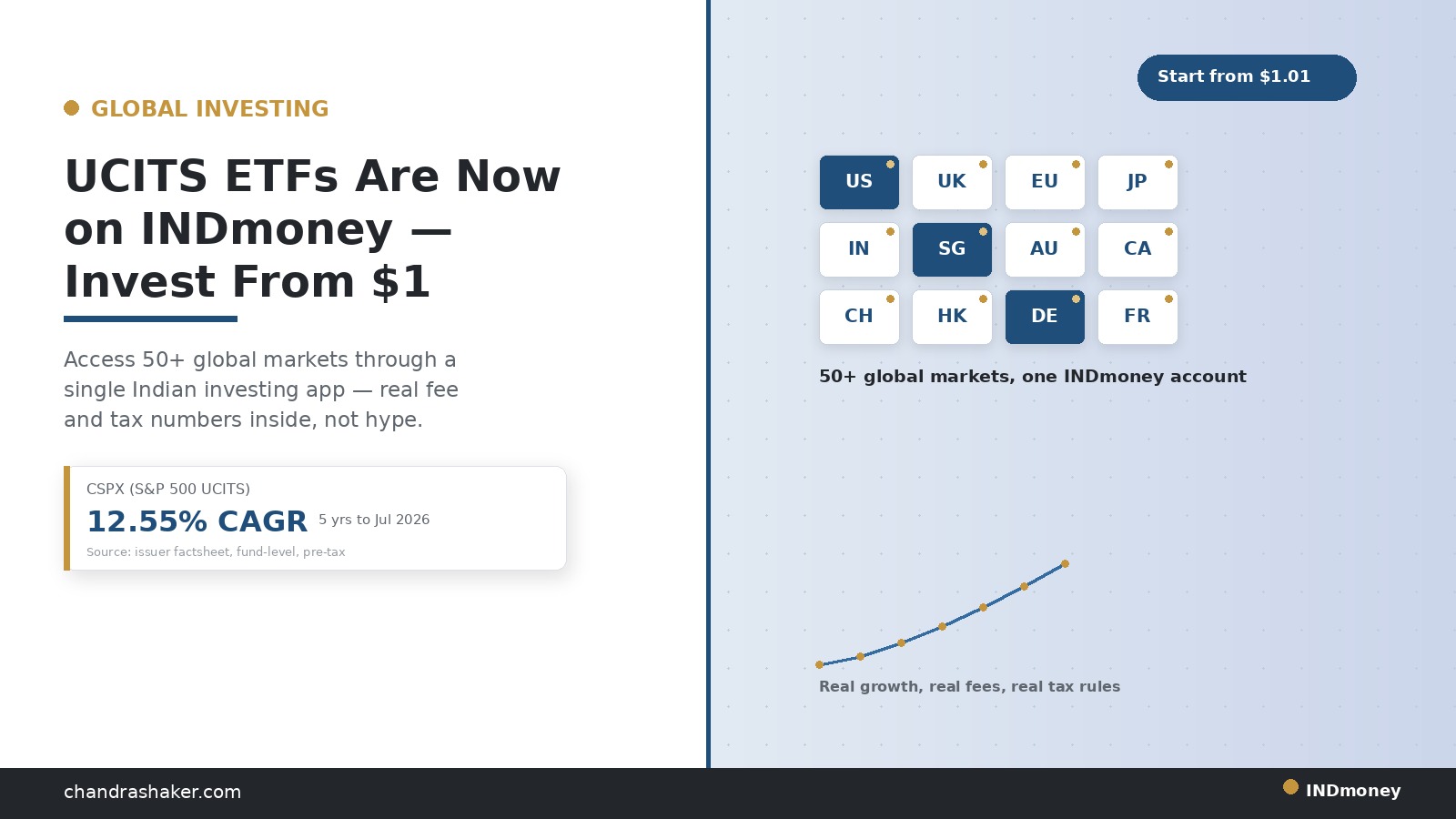
Here’s a number worth sitting with: a Nifty 50 index fund has delivered 6.90% a year over the last 5 years. The same money, in an S&P 500 fund, delivered close to double that — whether you accessed it through a US-listed ETF or, now, through a UCITS ETF right from your INDmoney account in India.

That’s not a sales pitch — it’s what the actual, published 5-year numbers show, and it’s exactly why UCITS ETFs matter for Indian investors right now. Until recently, reaching that US exposure meant a US brokerage account. Now, INDmoney has opened up UCITS ETFs — European-domiciled funds that give Indian investors access to over 50 global markets, including the S&P 500, through the same app already used for US stocks, with fractional investing starting from as little as $1.01.

SIP vs Lump Sum: Which One Really Wins in India? (2026 Data)

SIP vs Lump Sum: Which One Really Wins in India? (2026 Data)

You have ₹1,00,000 to invest. Do you put it in all at once, or spread it out through a SIP over the next few months?

Ask a mutual fund distributor and you’ll hear: “Do SIP, it protects you from market ups and downs.”

Ask someone who follows the data and you’ll hear: “Lump sum wins, because your money gets more time in the market.”

Both are partly right. But they’re both skipping one simple question — the one that actually decides the answer for you:

Mutual Fund Sahi Hai? Or Is an Index Fund Better?

Mutual Fund Sahi Hai? Or Is an Index Fund Better?

84% of large-cap active funds in India failed to beat their own benchmark over 10 years. That’s not a hot take — it’s S&P’s own scorecard. I’ll show you the exact numbers below.

“Mutual Fund Sahi Hai.” You’ve heard that line more times than you can count — on TV, on YouTube pre-rolls, maybe from a relative who “does SIPs.” It’s a good campaign. It got an entire country investing instead of only buying gold and fixed deposits.

AI Is Cutting Indian IT Jobs in 2026: How to Financially Prepare Before It Happens to You

AI Is Cutting Indian IT Jobs in 2026: How to Financially Prepare Before It Happens to You

A few years ago, “job loss” conversations in Indian IT meant recession fears borrowed from the US — Twitter layoffs, Amazon layoffs, a headline that felt far away. That’s not what 2026 looks like. This year’s job losses aren’t announced in press releases. They’re happening quietly, one performance review at a time, and the reason isn’t a slowing economy — it’s AI.

If you work in Indian IT, this affects you whether or not you’ve felt it yet. Here’s the actual data, and a concrete plan for what to do about it.

How to Invest in US Stocks from India: The Complete Guide

How to Invest in US Stocks from India: The Complete Guide

For years, I told myself Indian markets were enough. Then two things changed my thinking completely.

First, Nifty 50 has delivered close to zero real returns for investors who entered in late 2024. The index touched 26,000, corrected sharply — touching a low near 22,200, and has struggled to recover. Midcap and smallcap indices — where the “wealth creation stories” were loudest — have corrected 25–35% from peaks. Meanwhile, anyone with US exposure watched their portfolio quietly compound.

Bitcoin Crashed 48% From Peak: Is This the Time Indian Investors Should Buy?

Bitcoin hit an all-time high of $126,080 in October 2025. Today it’s trading around $65,000 — a brutal 48% crash.

Everyone who FOMOed at the top is now panicking. Everyone who missed out is asking: “Is it too late? Or is this my chance?”

If you’re an Indian investor wondering whether to buy Bitcoin during this dip, this post will help you decide. No hype, no predictions. Just facts about what Bitcoin actually is as an investment, how it compares to assets you already know, and what the real costs are in India.

Gold Crashed ₹50,000, Silver Down 39%: What Happened in Indian Markets & What to Do Now

Thursday: Gold Was ₹17,885 per Gram. Monday: ₹15,153.

That’s ₹2,732 gone per gram. In three trading days.

If you bought 100 grams of gold last Thursday (₹17.8 lakh), by Monday it was worth ₹15.1 lakh. You just watched ₹2.7 lakh disappear.

Silver? Even more brutal. From ₹4.2 lakh per kg to ₹2.5 lakh per kg. Down ₹1.65 lakh per kilogram.

Let me explain what just happened in Indian gold and silver markets, why the Union Budget duty cut didn’t prevent this crash, and what you should do if you’re planning to buy or already holding.

Union Budget 2026 Explained: What's Getting Cheaper, What's Getting Costlier & What It All Means for You

So… Budget 2026 Happened. Here’s What You Need to Know.

Finance Minister Nirmala Sitharaman just presented her 9th consecutive budget yesterday (February 1, 2026) - and fun fact, it’s the first Sunday budget presentation since 1999! I spent the entire evening going through the budget documents, watching the speech, and honestly… it’s a mixed bag.

As someone who teaches engineering students and also manages my own investments (Indian stocks, mutual funds, ETFs, US stocks through INDMoney), I wanted to break down what this budget actually means for regular people like us. Not the jargon-heavy analysis you’ll find everywhere else, but a straightforward explanation.

e-Rupee: RBI launches retail digital rupee e₹-R

e-Rupee: RBI launches retail digital rupee e₹-R

The pilot launch of the Reserve Bank of India’s (RBI) retail digital currency, called the e-Rupee or digital rupee, became live on 1st December 2022. e-Rupee or digital rupee is the electronic form of sovereign currency called central bank digital currency (CBDC).

According to the Reserve Bank of India notifications issued on 7th October and 29th November 2022, RBI is piloting the retail digital rupee.

Table of ContentsWhat is retail e-Rupee?How is the retail e-Rupee?Who issues and manages the retail e-Rupee?What are the participating banks and cities for pilot launch of e-Rupee?Who can use retail e-Rupee?How to use e₹-R?Reasonable, secure, and more effortless payments for all